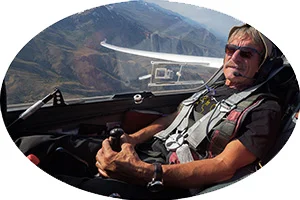
Here is the comprehensive English description of the interview, highlighting all the technical details and project plans discussed by Klaus and Karl:
Technical Highlights & Propulsion Concept
The Electric Motor: The modified Stemme S10 utilizes an *Emrax 228 motor, delivering **70 kW of maximum power* to successfully handle the glider’s 900 kg maximum takeoff weight.
Redundant Dual Cooling: To ensure self-launch capability even in hot summer conditions (30–40°C), the aircraft features a combined air- and liquid-cooling system. The liquid cooling is entirely redundant, equipped with three independent water pumps and three radiators for the motor and power electronics. If one system fails, the aircraft can safely sustain flight on reduced power via air cooling alone.
Cockpit & Avionics: The cockpit setup remains straightforward but modern, featuring a large TFT touch panel for propulsion monitoring. Mirroring standard FES configurations, critical components are fully redundant, including dual power switches for the two sets of power electronics and redundant control potentiometers.
No Structural Changes: To ensure the Supplemental Type Certificate (STC) process remains feasible, the battery packs are integrated directly onto the original Rotax engine mounting points. The mass of the non-lifting parts remains virtually identical to the original aircraft, simplifying future certification.
Range & Regeneration via “Windmilling”
Phase 1 (Pure Battery Flight): The initial test phase uses a *30 kWh battery pack*. Cruising at the best glide speed (120 km/h) requires only about 10 kW of power, allowing for nearly 3 hours of level flight—roughly a 300 to 400 km range purely on battery power without any thermal assist.
In-Flight Recharging: A key feature for wave flying is the system’s ability to recharge the batteries in-flight via *windmilling. By regulating the propeller speed during a descent or in strong wave lift, the system can regenerate up to **10 kW of power*, effectively turning the propeller into a small air brake that feeds energy back into the pack.
Phase 2: The Range Extender & World Flight
The Range Extender Setup:
For long-distance expeditions, Phase 2 will introduce a small Briggs & Stratton industrial combustion engine paired with an *Emrax 188 generator, producing **25 kW of continuous cruising power*. While 25 kW is not enough to self-launch, it is ideal for maintaining efficient level flight.
* *Fuel Efficiency:* In this configuration, the battery capacity will be scaled down to under 10 kWh to maintain the weight limits. The range extender burns a mere *5 liters of fuel per hour*. Utilizing the Stemme’s original 120-liter wing tanks, the calculated range becomes immense.
Expedition Plans for 2027
Klaus emphasizes that this project is focused on education, engineering appreciation, and historical storytelling rather than just speed:
The Aéropostale Route: The global flight path will trace the pioneering French airmail routes, flying from Toulouse to Dakar, crossing the Atlantic to Natal (Brazil), continuing down to Buenos Aires, and crossing the Andes. Along the way, Klaus plans to stop at universities to give speeches on sustainable aviation technology.
The Lindbergh Anniversary: A major highlight of the journey is planned for *May 2027*, marking the 100th anniversary of Charles Lindbergh’s transatlantic flight. Klaus aims to replicate the historic New York to Paris route solo in the hybrid-electric Stemme, arriving to coincide with the Paris Air Show after nearly 6,000 km of ocean crossing.
Commercial Potential
Karl notes that interest from the Stemme community is already very high. Once the STC is secured, the goal is to offer this conversion kit as a commercial package. Positioned at a price point comparable to a standard 2,000-hour Rotax engine replacement, it will offer owners a vibration-free, silent, emission-free, and highly reliable alternative.